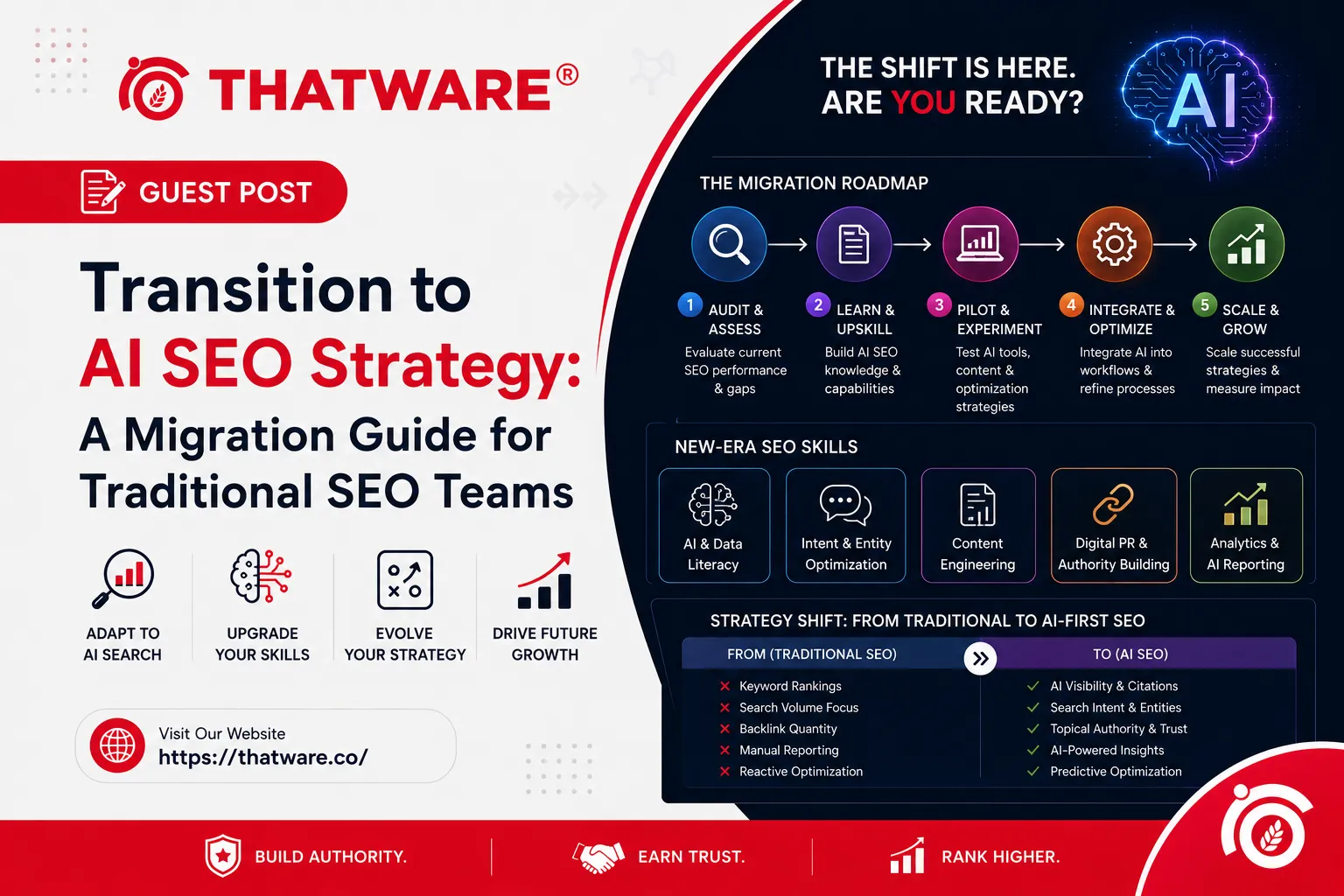
If you’ve been doing SEO for more than five years, you’ve already navigated at least one major transition. Penguin and Panda, if you go back far enough. Mobile-first indexing. Core Web Vitals. E-A-T becoming E-E-A-T. Every few years, the discipline evolves substantially and teams have to update their mental models, their tools, and their tactics.
The transition to AI SEO strategy is the biggest one yet. Not because everything changes — the foundations of good SEO still hold. But because the strategic layer sitting above those foundations needs significant updating.
Here’s a practical migration guide for teams making that transition.
Step One: Audit Your Current Posture
Before making changes, understand where you are. How much of your current traffic comes from informational queries that are increasingly served by AI Overviews? What percentage of your content is optimized primarily for keyword ranking versus actual question-answering quality? Does your site have robust structured data, or is that still on the roadmap?
Run a gap analysis against AI citation readiness: entity clarity, author authority signals, content directness, structured data implementation, third-party credibility indicators. This gives you a baseline and a prioritized action list.
Step Two: Update Your Content Quality Standards
The content quality bar for AI SEO is higher than for traditional keyword-optimized content. Vague, padded content that ranks on authority doesn’t get cited by AI systems the way it might rank in traditional search. Content needs to be specific, direct, evidence-backed, and clearly written by humans with genuine expertise.
Update your editorial guidelines to reflect this. Add a “citation quality” criterion to your content review process: would an AI system choose to cite this content to answer a relevant question? If not, what would need to change?
Transitioning to AI SEO strategy often requires pruning low-quality existing content — pages that rank but don’t serve users well, thin category pages, duplicate content — because these can dilute the overall quality signal of your domain.
Step Three: Build Author and Entity Infrastructure
If your site publishes content under “editorial team” or byline-free, this is the moment to change that. Build out author profiles for your key content creators. Include credentials, professional background, links to external profiles, and areas of expertise. This is a visible trust signal for both human readers and AI systems.
Ensure your brand entity is clearly defined: consistent brand description across all channels, Google Business Profile accuracy, LinkedIn company page completeness, and structured data on your website that clearly describes your organization.
Step Four: Add GEO Metrics to Your Reporting
You can’t optimize what you don’t measure. Start tracking AI citations alongside traditional search metrics. Tools for monitoring brand mentions in AI outputs are emerging — use them. Track whether your brand appears in AI-generated answers for your target queries, and use that data to inform content priorities.
Implementing an AI SEO strategy means expanding your definition of success beyond rankings and clicks to include AI visibility, brand citation frequency, and entity authority.
Step Five: Update Your Stakeholder Communication
One of the underrated challenges of this transition is internal communication. Executives and clients used to measuring SEO performance through ranking reports and organic traffic numbers need to understand the new metrics — and why a slight traffic dip from zero-click queries doesn’t mean the strategy is failing.
Educating stakeholders about the new landscape, setting updated success metrics, and building the business case for AI SEO investment is a real part of the migration work. Done well, it creates organizational alignment that makes the strategic transition much smoother.